
Marion City Directory Shelves
The firmest local run comes from the City of Ocala Historic Resources Report. Its bibliography names R. L. Polk as editor and publisher and identifies the exact editions consulted. Catalogs add earlier leads, while state and federal repositories provide fallback access.
| Collection | Years | Where held | Access |
|---|---|---|---|
| R. L. Polk Ocala City Directory | 1914, 1919, 1923, 1925, 1927, 1930, 1937, 1940, 1945, 1947, 1949, 1951, 1953, 1955, 1957-1961, 1965, 1970 | Marion library; online subscription | Verify title page and key |
| Earlier Ocala directory leads | 1908, 1911; overlapping 1908-1960 reports | FamilySearch, Allen County, other catalogs | Some images gated |
| NARA Ocala microfilm | 1925, 1927, 1930 | National Archives list | Strong 1930 census bridge |
| Florida Collection | Early 1900s to present statewide holdings | State Library of Florida | On-site reference use |
| Federal census | Public schedules through 1950 | NARA, library, FamilySearch | Household context |
These are known issues, not proof of annual publication. Missing years must remain gaps until a catalog record and title page confirm them.
Verify Ocala Polk Directory Years
The verified Polk list begins with 1914 and ends with 1970, but it is uneven. There is no basis for filling the spaces with assumed annual editions. Each Marion County city directory citation should include the volume title, publication year, page, repository, and the date it was consulted. Canvassing may have happened before the imprint year, so a directory address is best read as dated evidence rather than an exact move date.
The Marion County directory bibliography points to the 1908 and 1911 issues and digitized repository leads.
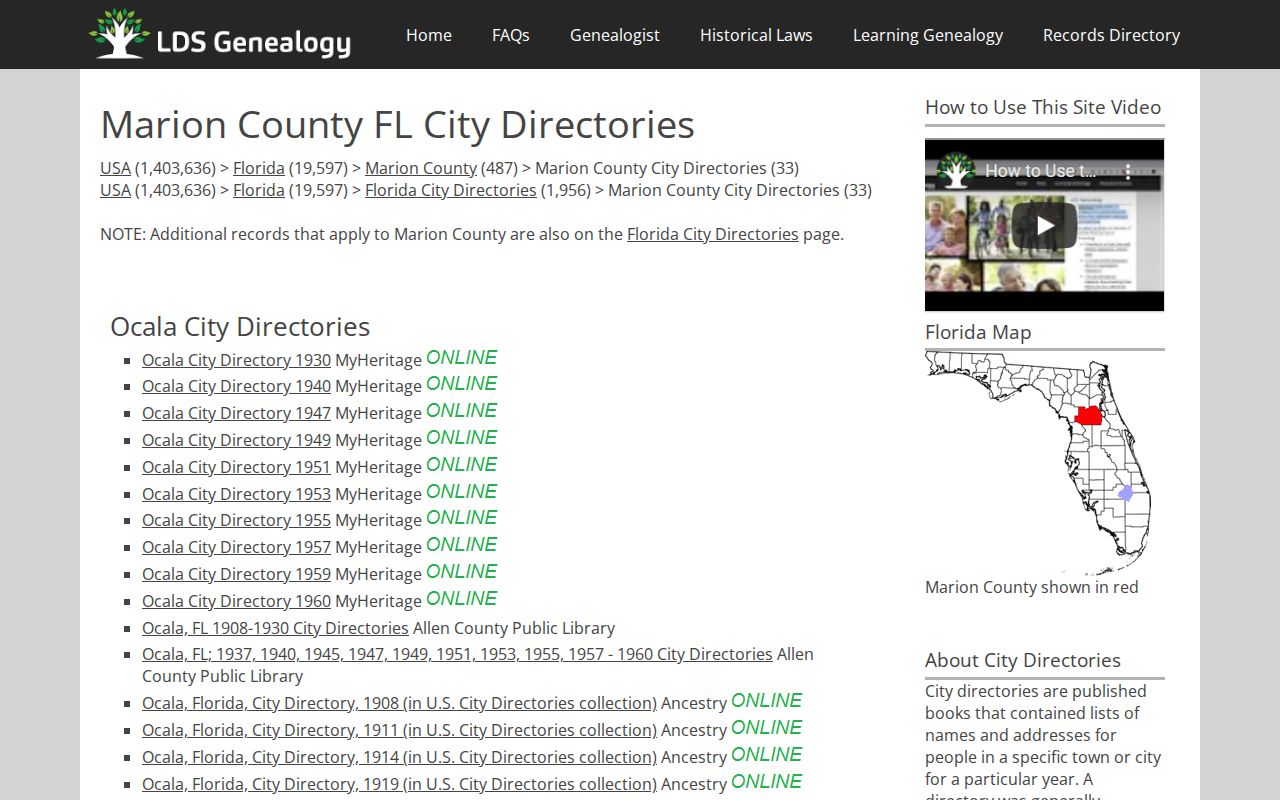
Use that inventory to locate a volume, then inspect the scan or book itself before quoting an entry.
Find Marion Directory Repositories
Start with Marion County Public Library System. Its databases page lists telephone-directory resources, newspapers, HeritageHub, Florida Memory, and the Historic Marion County Digital Collection. Headquarters-Ocala is at 2720 E Silver Springs Boulevard and can be reached at 352-671-8551. Ask the reference desk to verify an exact year and format before traveling.
The State Library of Florida guide explains its Florida Collection, arranged first by city and then by date.
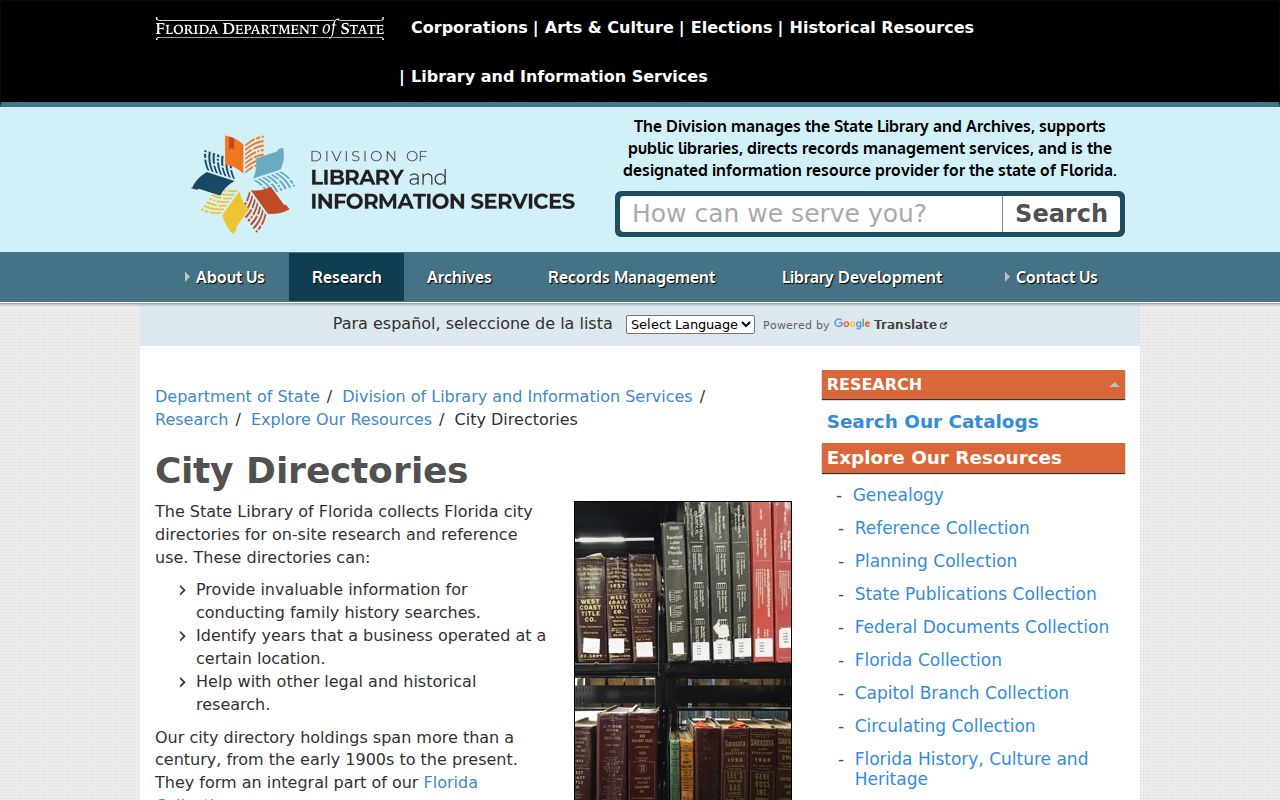
The State Library reference line is 850-245-6682. NARA separately lists Ocala directories for 1925, 1927, and 1930. These channels matter when a local shelf lacks an issue or a web image requires a login.
Read an Ocala Directory Entry
No open scan in the research supplied a safe named sample, so no local abbreviation should be invented. Typical fields must be checked against the front-matter key in the exact Marion County city directory being used.
| Name | Surname, given name, and initials |
|---|---|
| Spouse | Often appears in parentheses, depending on the year |
| Widow notation | May name a deceased spouse |
| Occupation | Trade, job title, and sometimes employer |
| Address | Home or business location, interpreted with the key |
| Home mark | A symbol may distinguish ownership, but only if the key says so |
- Criss-cross directory
- A street-order section that begins with an address rather than a surname.
- Householder index
- An index centered on the person listed as head of a household.
- Abbreviation key
- The publisher's code list, usually in the front matter, needed to decode marks.
Photograph or save the title page and key before the entry. A single letter can change the meaning from residence to boards, rooms, or business location.
Switch Marion Directory Search Modes
An alphabetical section moves from person to address. A reverse or criss-cross section moves from address to the listed householder or business. A telephone book is a third tool. It may omit non-subscribers and often lacks occupation or employer detail. These formats should not be treated as interchangeable.
The FamilySearch Marion catalog search includes a title described as covering Ocala and Marion County, with a buyers' guide and classified business directory.
Catalog descriptions are leads. Confirm the imprint, coverage, and image access in the record for each volume.
Pair Marion Directories With Census
Directories fill the space between public federal census schedules. The public census extends through 1950 as of 2026 under the 72-year rule. The 1960 schedules are expected in 2032, so Polk editions from 1961, 1965, and 1970 reach beyond current census access.
- Copy the person's full directory entry and cite its year and page.
- Check the issue just before and after it, recording every move and spelling change.
- Use a street section, if present, to test the address and nearby names.
- Bridge 1919 to the 1920 census, 1925 or 1930 to the 1930 census, and 1940 or 1951 to nearby public schedules.
- Use deeds, obituaries, and probate to explain ownership changes, death, or disappearance from the run.
A disappearance can mean a move, death, omission, change of name, or a volume gap. It is not proof of any one event. Search a spouse, widow notation, adult child, or old address before ending the trail.
Cross Ocala's 1958 Divide
Ocala adopted a quadrant street naming system in 1958, and most streets were renamed. Address-only matching can therefore split one home into two apparent places. Compare editions on both sides of 1958, then use plats, legal descriptions, deeds, and Sanborn maps to connect the former name with the newer one.
The available Ocala Sanborn editions date from 1884, 1886, 1888, 1891, 1895, 1901, 1906, 1912, and 1924. They show building footprints, use, numbers, and street continuity, not occupant names. A modern address search belongs in the By Street, while historical city directories preserve the dated resident layer.
Note: Search both street names and cite the source that proves they identify the same place.
Add Marion Newspapers and Images
A short city directory line becomes more useful beside local context. The Marion library offers the Ocala Star-Banner archive, HeritageHub obituaries and death notices, Florida Memory, and a Historic Marion County Digital Collection with more than 1,000 photographs, postcards, and prints from the late nineteenth through mid-twentieth century. Images may show a storefront, block, road, or neighborhood that the entry only names.
HeritageHub spans 1704 to the present nationally, but local newspaper coverage varies. Treat an obituary as a published account and use probate or a death record for the legal event. Likewise, a photograph caption is a lead until its date and location are checked.
Marion County was formed in 1844, before Florida statehood. Early material may be cataloged under territorial or parent-county terms. A December 21, 1844 instrument appears under Alachua County in the WPA history, which is a useful warning against forcing modern geography onto old indexes.
Ask Marion Genealogy Volunteers
The Marion County Genealogical Society works with library volunteers. Its research service says simple Marion lookups are free. County residents can receive live library help, and new members can receive up to two hours of personal assistance. Volunteer findings remain leads, so cite the directory image, census page, obituary, deed, or other underlying source.
The Genealogical Society research page explains the service.
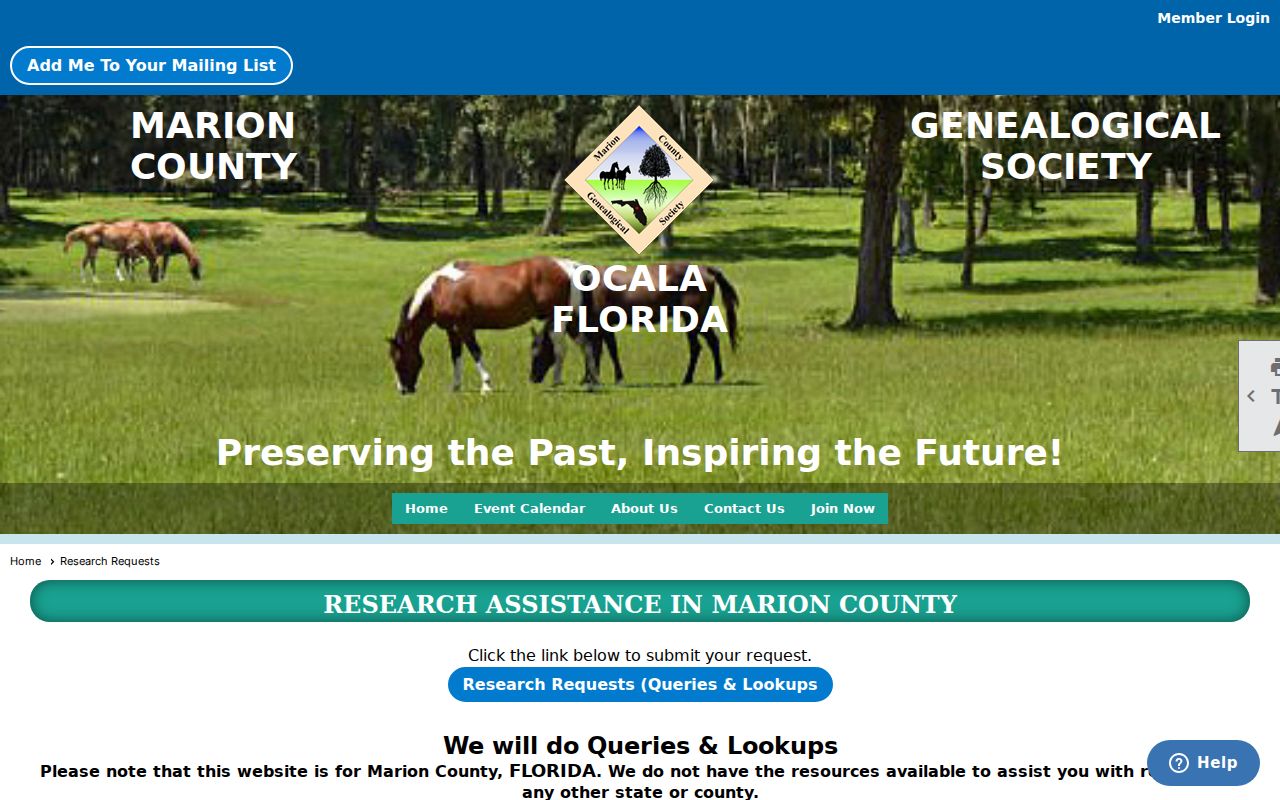
The society is at 4970 SW Second Street in Ocala, telephone 352-897-0840. The Marion County Museum of History and Archaeology also maintains history, archaeology, and genealogy libraries at 307 SE 26th Terrace.
Cite Marion Directories Carefully
Paywalls and missing scans do not justify copying an uncited online tree or inventing an entry. Record the repository, publication title, year, page, and access date. Keep the abbreviation key with the citation. If a catalog says that city directories exist, verify each year separately.
A Marion County city directory is a snapshot, not a current resident roll. Publication lag, canvass timing, omissions, and name changes all matter. Pair it with another independent source, and do not publish protected or sensitive address details merely because an old index can be found.
Cite Marion Directory Findings
A useful city directory citation names the publisher, exact volume year, page, section, repository, and date accessed. Photograph or transcribe the title page and abbreviation key along with the entry. A name beside an address may identify a spouse, occupation, employer, widowhood status, or home ownership through abbreviations that change by publisher and year. Do not expand an abbreviation until the key in that same volume confirms its meaning.
Coverage is not annual merely because a catalog gives a broad range. The verified R. L. Polk Ocala run reaches from 1914 through 1970, but individual issues are noncontinuous. Earlier 1908 and 1911 references are catalog leads that should be checked against their title pages. When a year is absent, bracket the household with the nearest editions, then compare a census schedule, deed, obituary, probate file, newspaper item, or Sanborn map. That method distinguishes a real move from a missing volume and keeps each historical claim tied to dated evidence.