
Marion County Address History Sources
No single roll names everyone who occupied a Marion County property. Deeds establish title, parcel cards connect today's street address to a legal description, and dated directories or census schedules can identify people who actually lived there. Start with the source closest to the period being studied, but preserve the parcel number, legal description, book and page, and each spelling of a party name as the trail moves back.
| Source | Years It Covers | Where Held | What It Shows |
|---|---|---|---|
| Official Records online | 1967-present | Marion County Clerk online | Deeds, mortgages, liens, judgments, and related instruments |
| Earlier deed books | Before 1967 | Clerk Records Center | Older transfers by name, year, and book/page |
| Ocala city and reverse directories | Verified Polk issues, 1914-1970 | Marion library and Ancestry | Dated occupants between census years |
| Federal census | 1850-1950 currently public | NARA, FamilySearch, and library access | Named households at ten-year intervals |
| Ocala Sanborn maps | 1884-1924 | Library of Congress | Building footprint, use, and old street labels |
For a recent sale, use the parcel card and Official Records. For a mid-century household, pair the deed chain with a nearby Polk issue and the closest public census. The oldest Marion County address research may require territorial or parent-county catalog terms because Marion was organized before Florida became a state. That early history also explains why modern web coverage is only one part of a much older record trail.
Fix the Marion County Parcel
Open the Marion County Property Appraiser Property Search and choose Address. The search accepts fragments and standard street suffixes, but it covers improved parcels, so a vacant gap is better handled through Map It+. Copy the parcel identifier, situs address, owner mailing address, legal description, and latest Official Records book and page. Situs means the physical location of the land; it can differ from the address where the owner receives mail.
The property card may also show subdivision references, sales, exemptions, building facts, and a homestead indicator. A matching mailing and situs address plus homestead is consistent with owner occupancy, but it does not prove who else lived there. Previous residents may include renters, relatives, and other household members who never appear in the title record. Keep that distinction visible throughout the search.
Note: A parcel identifier and legal description survive many street-label changes, making them safer anchors than an old address alone.
Walk Marion County Deeds Backward
The Marion County Official Records Search is a party index for recorded instruments. A grantee receives an interest; a grantor transfers it. The chain of title is the linked series of those transfers for the same land. Search names with a recording-date range, then confirm the document type, parties, book/page or file number, and legal description. A matching surname without matching land is not enough.
- Pull the current owner, parcel ID, legal description, and latest deed reference from the Property Appraiser.
- Open that purchase deed and record the buyer, seller, date, instrument number, and exact land description.
- Search the seller as an earlier grantee. Check name variants and narrow the date range when results are broad.
- Confirm the same legal description, then repeat from buyer to seller until the online trail ends.
- Carry the names, years, and book/page references to the Records Center for older deed books.
- Grantor / grantee
- The grantor gives or sells an interest; the grantee receives it.
- Chain of title
- The linked sequence of deeds and other instruments affecting the same parcel.
- Legal description
- The formal land description in a deed or plat, which can remain stable when street numbers change.
Marion's Historic Records Bridge
The Clerk provides a separate Historic Official Records portal for 1959 through 1964. It searches item number, grantor, grantee, document type, date, book, page, and legal description. It also supports search operators and TIFF image downloads. This bridge matters because the Clerk's Research Request page describes regular online images from 1967 forward, while another Records Center page cites 1965. Treat each series and portal on its stated terms.
The Clerk's historic-records screen shows why a separate search is needed for this period. The source page can be reviewed before entering a party name.
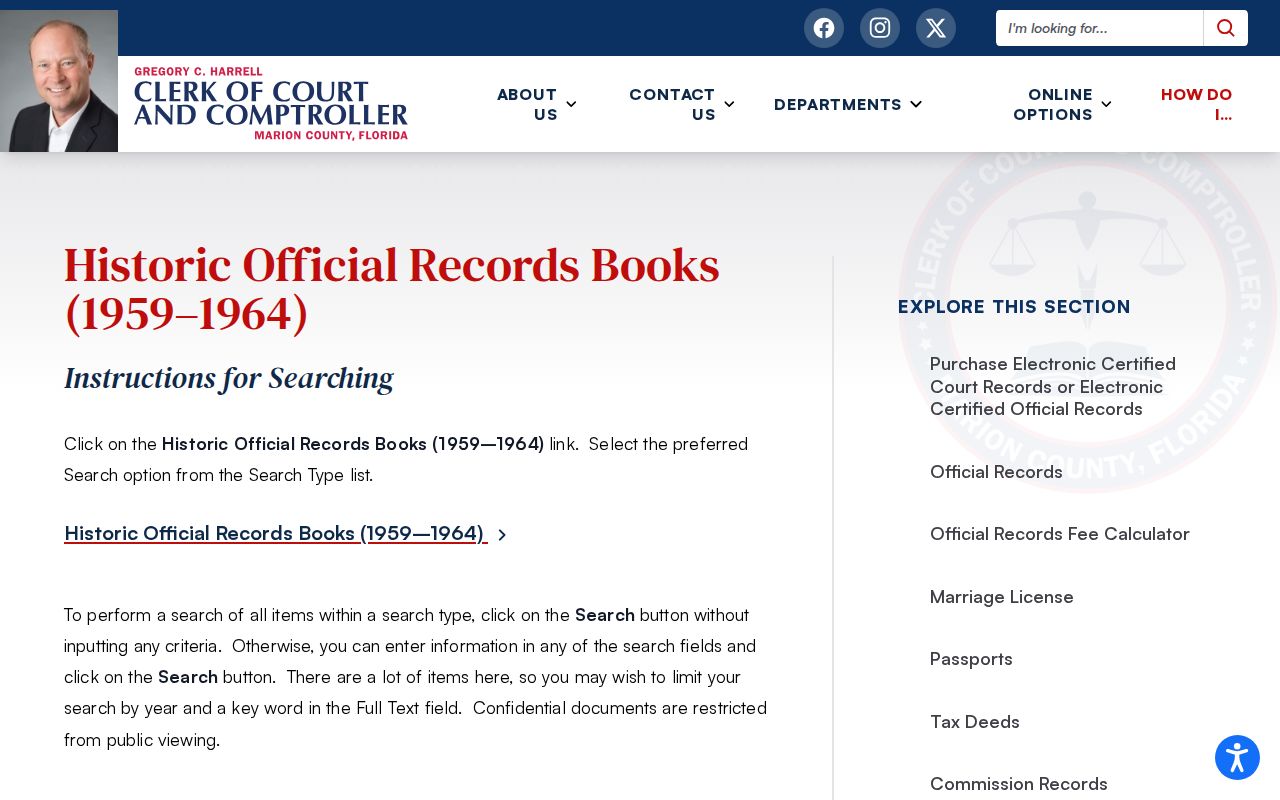
The captured interface is a period-specific route, not proof that every older instrument has a public image. Record its citation before moving to the next seller.
Earlier Marion County Resident Records
When the online chain stops, use the Clerk's Records Center research request. Give the document type, party or owner name, year or date range, and any book/page or file number already found. The verified charge is $2 per name for each year searched, with copies at $1 per page and certification at $2 per document. Mail goes to P.O. Box 1030 rather than the physical research site at 870 NW Fourth Avenue.
The request page makes the pre-web fallback concrete for Marion County previous residents.
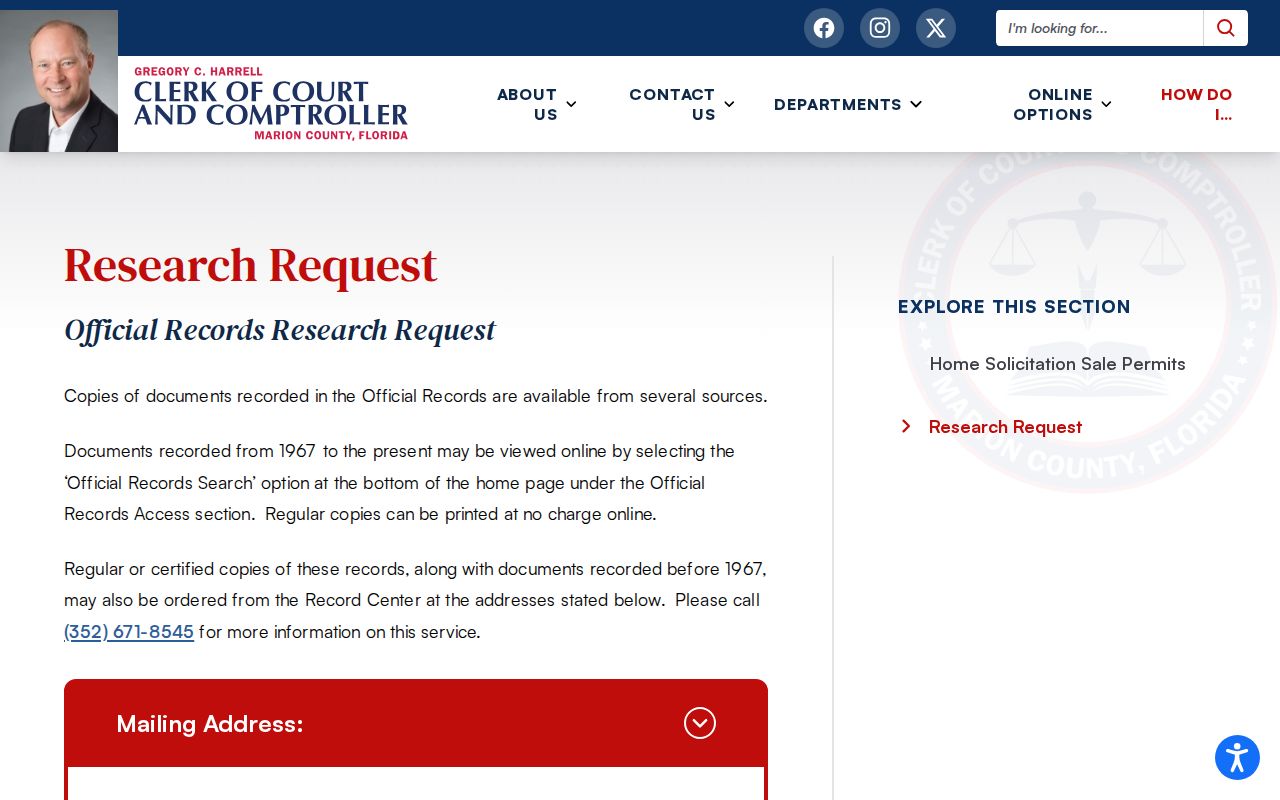
Use the response to extend the same legal chain, then add occupancy sources. A certified copy is useful when formal proof is needed; a free web print often suffices for personal house-history notes.
Map Old Marion County Addresses
Deeds follow land, but maps explain what stood there. The Library of Congress Sanborn collection includes Ocala editions from 1884, 1886, 1888, 1891, 1895, 1901, 1906, 1912, and 1924. The last atlas contains 34 sheets and includes associated coverage for Oak, Zuber, Fort McCoy, and Reddick. These fire-insurance maps show footprint, construction, use, and former street labeling. They do not name occupants.
Compare the street name, number, nearby corners, and building outline with a directory and plat. This is especially useful at a renaming break or where a building was rebuilt on the same lot. Historic boundaries also matter: Marion County was created in 1844, and later territory shifted to Sumter, Levy, and Putnam. Search under the county that kept the record at the time.
Note: The 1883 Ocala business fire prompted brick rebuilding, but no authoritative source found that courthouse books were destroyed.
Missing Marion Records May Survive
“Not online” does not mean “does not exist” in Marion County. The county's recordkeeping began long before the modern Official Records browser. Pre-1967 instruments have a named Records Center route, and marriage licenses before the online 1965 cutoff remain on microfilm. Older volumes may require a party name, year, and book/page rather than a street address. That is why each online citation should be saved before the search moves to the counter or a mailed request.
The scale of current indexing also calls for careful date filters. In 2024, the Clerk recorded, verified, and indexed 171,275 Official Records documents, an average of 693 per day. A broad surname can therefore produce many unrelated instruments. Add a first name, document type, recording window, and party role, then verify the legal description. The Clerk reports permanent archival treatment for recorded instruments and offsite storage of an original microfilm roll, so the web image is an access copy rather than the whole preservation system.
Note: Save negative search terms and date ranges so Records Center staff can see what was checked before a manual search begins.
Place Marion County Past Residents
Ownership is only half of an address timeline. The verified R. L. Polk Ocala run includes issues from 1914 through 1970, with gaps. An alphabetical directory starts with a surname, while a reverse or criss-cross directory starts with a street address. The exact reverse-section years have not been published, so verify the title page and front-matter key for each volume. The collection details belong to the City Directories page.
Pair each usable directory with a nearby census schedule. Federal population schedules through 1950 are public under the 72-year rule. A 1930 directory and census can turn a terse address line into a household with ages, relationships, birthplaces, and occupations recorded at that time. Directories between census years help track moves, spouse names, widow notations, and adult children.
- Copy the address entry exactly, including street direction, suffix, and any old number.
- Check the directory key, then compare the year before and after if both exist.
- Find the closest census enumeration area and confirm the household on the schedule.
- Return to the deed timeline to separate an owner from a renter or other occupant.
Obituaries, cemetery indexes, and probate files can close a trail when a resident died or title passed to heirs. The Marion County library's HeritageHub access and local newspaper archive provide names and family links; Clerk probate files establish the legal case. Treat an obituary as a lead and confirm the transfer in the deed or probate record.
Lawful use. Research Marion County previous residents for family, heir, or house history. Never use an address trail to stalk, harass, intimidate, or harm a living person.